Key takeaways
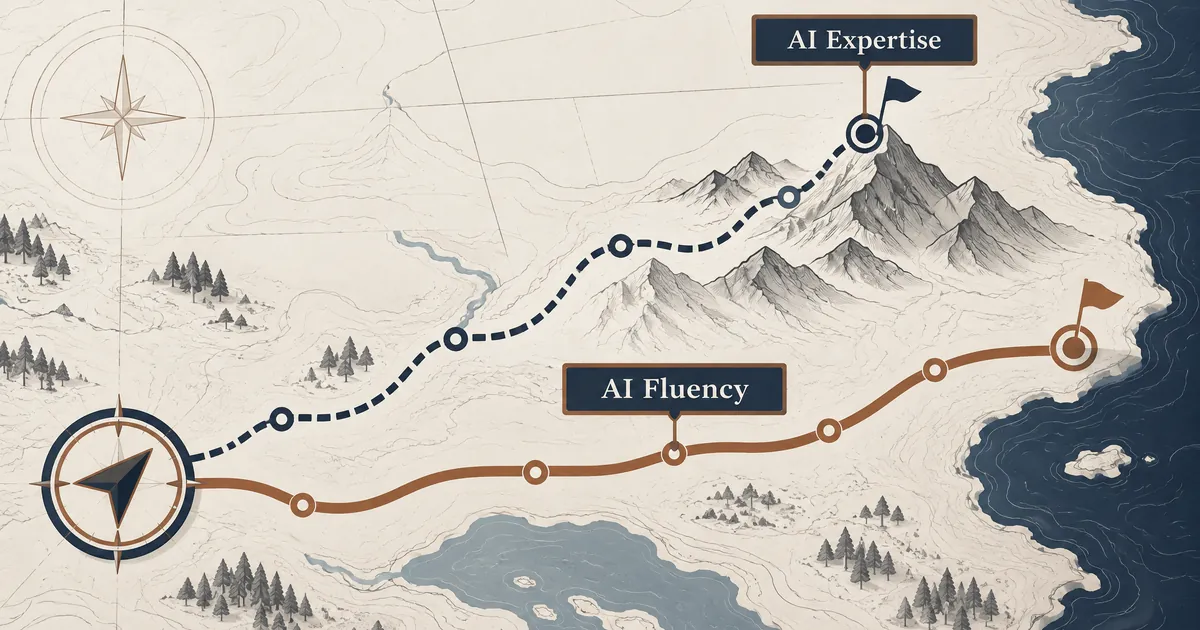
- AI fluency is the practical ability to use AI tools responsibly, while AI expertise is the deeper ability to build, evaluate, manage, or govern AI systems.
- Most professionals need AI fluency before they need AI expertise.
- The right level of AI learning depends on a person's role, field, career stage, and next direction.
Not everyone needs to become an AI expert.
That may be the most useful place to begin.
As AI becomes part of more workplaces, many professionals feel pressure to learn more. Some assume they need deep technical knowledge to stay relevant. Others avoid the topic because it feels too complex.
Both reactions are understandable.
But there is a better way to think about it.
Most professionals do not need AI expertise.
They need AI fluency.
The difference matters.
What is AI fluency?
AI fluency means having enough understanding to use AI tools thoughtfully, ask good questions, judge outputs, and make responsible decisions in your own work.
It does not mean knowing how to build AI systems.
It does not mean understanding every technical detail.
It does not mean using AI for everything.
A fluent professional can:
- Explain in simple terms what AI can and cannot do
- Identify where AI may help in their work
- Use tools for appropriate tasks
- Review results carefully
- Protect confidential information
- Recognize when human judgment is needed
- Understand basic risks such as errors, bias, and overreliance
- Keep learning as tools change
This is practical knowledge.
It helps you work with more confidence.
What is AI expertise?
AI expertise is deeper and more technical.
An AI expert may design, build, test, improve, or manage AI systems. They may work in data science, machine learning, software development, AI governance, research, cybersecurity, or related technical fields.
This level of expertise requires more formal study and practice.
It may involve mathematics, coding, data management, model evaluation, systems design, policy, and risk management.
Some professionals need this.
Most do not.
A person working in an AI product role may need technical depth. A data scientist certainly does. A technology leader may need enough expertise to make strategic decisions. A compliance or governance specialist may need more detailed knowledge of risk and regulation.
But a teacher, accountant, nurse, project manager, career advisor, nonprofit leader, HR professional, or small business owner usually does not need to become an AI engineer.
They need to understand how AI affects their own work and decisions.
Why the distinction matters
When people confuse fluency with expertise, they often make poor learning decisions.
Some overreact.
They sign up for technical programs they do not need. They spend time and money learning content that does not connect to their role. They feel behind because the material is too advanced or irrelevant.
Others underreact.
They assume that because they are not technical, AI has nothing to do with them. They avoid learning altogether. They miss chances to improve their work or prepare for changes in their field.
Both paths create confusion.
The right question is not, "Should I learn AI?"
The right question is, "What level of AI understanding do I need for the work I do and the work I want next?"
That is a career planning question.
A simple way to understand the levels
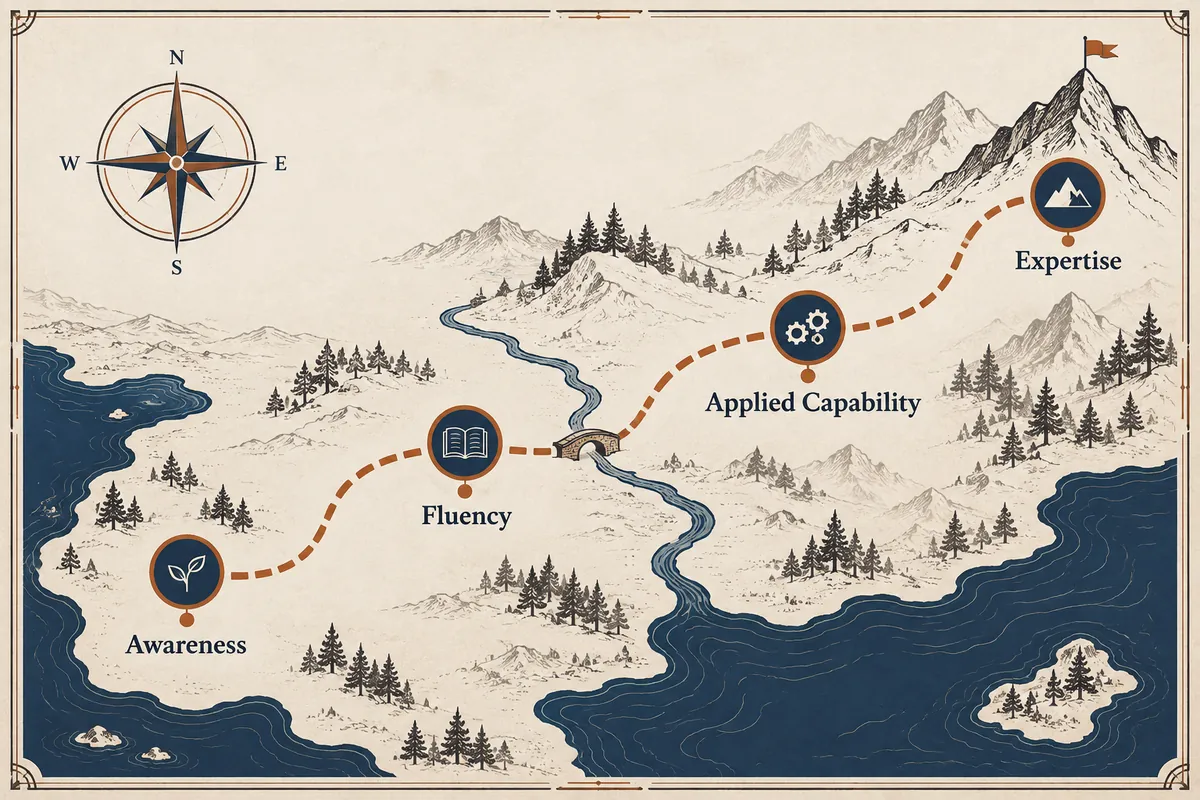
Think of AI learning in four levels.
Level 1: Awareness. You understand that AI is changing work. You know basic terms. You can follow a conversation without feeling lost.
Level 2: Fluency. You can use AI tools appropriately in your own work. You can ask better questions, check outputs, and understand basic risks.
Level 3: Applied capability. You can use AI in a specific professional context. For example, in marketing, HR, education, operations, finance, law, healthcare, or career advising. You know the use cases, limits, and responsibilities in your field.
Level 4: Expertise. You can design, build, evaluate, govern, or lead AI systems at a deeper level.
Most professionals should aim for Level 2 or Level 3.
That is enough to stay informed, useful, and adaptable in many roles.
What AI-fluent professionals know
AI-fluent professionals do not need to know everything.
But they do need a few practical understandings.
They know AI can be helpful, but not always correct.
They know AI can draft, summarize, organize, compare, and suggest. They also know it can make mistakes.
They know context matters.
A weak question often leads to a weak answer. A clear instruction leads to a better starting point.
They know private information needs care.
Not every document, client detail, employee issue, or personal record should be entered into a tool.
They know human review is essential.
AI can support work, but the professional remains responsible for the final decision.
They know the goal is better work, not just faster work.
Speed without judgment can create problems.
What different professionals may need
AI fluency looks different depending on the role.
A student may need to understand how to use AI responsibly for learning, research, and career preparation.
A new graduate may need to show employers they can adapt, communicate clearly, and use workplace tools with good judgment.
A mid-career professional may need to understand how their tasks are changing and which skills to strengthen.
An experienced leader may need to guide teams, set expectations, and make responsible decisions about adoption.
A career changer may need to use AI to explore options, identify transferable skills, and prepare materials, while still making grounded choices.
This is why one-size-fits-all advice does not work.
The right level of AI learning depends on the person, the role, and the direction.
When expertise is the right goal
There are times when AI expertise is the right goal.
You may need deeper expertise if you want to:
- Move into a technical AI role
- Build AI products
- Work in data science or machine learning
- Advise organizations on AI risk or governance
- Lead major AI implementation projects
- Specialize in AI policy, ethics, or regulation
- Teach advanced AI topics
If that is your path, take it seriously.
Build a structured learning plan. Expect depth. Get experience. Learn the foundations. Seek credible training and practice.
But do not choose this path out of fear.
Choose it because it fits your goals.
How to build AI fluency without overwhelm
Start with your own work.
Pick one task that is useful, low-risk, and familiar.
For example:
- Summarizing notes
- Preparing questions for a meeting
- Drafting a first version of an email
- Comparing job descriptions
- Organizing research
- Brainstorming interview examples
- Creating a learning plan
Use AI to support the task.
Then review the result.
Ask what was helpful, what was missing, and what needed correction.
This simple practice builds judgment.
You can then move to more complex tasks over time.
You do not need to learn everything at once.
You need repeated, thoughtful use.
AI fluency as part of career clarity
AI fluency is not only a workplace skill.
It is part of career clarity.
When you understand AI at the right level, you can make better decisions about your future.
You can assess your current role more accurately.
You can decide what to learn next.
You can speak more confidently in interviews.
You can lead conversations at work.
You can avoid both panic and denial.
This is why AI career advising matters.
It helps professionals understand what level of AI learning fits their career stage and goals.
The 4D Career Blueprint supports this process through Discover, Design, Develop, and Direction.
First, understand yourself and your current career position.
Then design possible paths.
Then develop the right skills.
Then move with direction.
What professionals actually need
Most professionals need enough AI fluency to stay aware, capable, and responsible.
They need to understand how their work is changing.
They need to use tools with care.
They need to strengthen the human skills that remain essential.
They need to choose learning that fits their goals.
Some will need expertise. Many will not.
The future does not belong only to technologists.
It belongs to people who can learn, adapt, think clearly, and use good judgment.
That is a practical goal.
That is a career goal.
No career left to chance.